Philosophy of Law Office: Hellems 182
Fall 2005 Phone: 492-6964
MCOL E186 Hours: TR 11:00-12:15
MWF 12:00-12:50 David.Boonin@Colorado.Edu
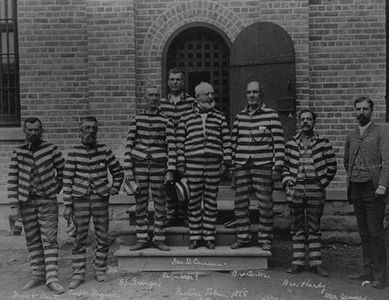
course description: This advanced undergraduate/graduate-level course offers a detailed, critical examination of one of the central issues in the philosophy of law: the problem of punishment. The legal institution of punishment involves treating people in ways that it is typically wrong to treat people (e.g., taking away their money, locking them up in cages, killing them). The problem of punishment arises from the fact that although virtually everyone agrees that the practice of punishing people for breaking the law is morally permissible, it is extremely difficult to say precisely why the fact that some people have broken the law renders it permissible to treat them in ways that it would otherwise be wrong to treat them. The course will begin by developing a detailed account of the nature of punishment and of the problem of justifying it. We will then devote the majority of the semester to a critical examination of various solutions to the problem that have been proposed in the philosophical literature on punishment, beginning with the two most prominent sorts of solutions (consequentialist and retributivist) and then moving on to a number of less orthodox positions (including self-defense, reprobative, educative, and consent-based models). The course will conclude with a detailed consideration of the alternative view that punishment should simply be abolished and replaced by a system of victim restitution, and, if there is time remaining after that, with discussion of one or two further topics related to punishment (such as capital punishment, corporal punishment, punishment of children, etc.). Class format will involve a mixture of lecture and discussion and how much time we spend on any one unit will depend largely on how much discussion that unit generates during class meetings.
required readings: All required readings are listed below and are available as electronic texts linked to this syllabus. Students who wish to access the readings electronically from off-campus computers should click here , for specific instructions about how to do so. Students are expected to come to class having done the required readings.
optional readings: There are two sets of optional readings provided for this course. The first set of readings consists of the current draft of a manuscript I am working on, tentatively entitled The Problem of Punishment . These readings correspond closely to each unit listed below, and will generally (though not always) include detailed discussions of the readings contained in those units. Click here for links to the versions of the chapters that are currently available online. The second set of optional readings consists of a number of journal articles that are related to some of the particular units below. These readings are also available online, and can be found by clicking here .
course requirements: Final grades will be based on a combination of written work and class participation. Class participation is construed broadly to include conversations with me during office hours and correspondence via e-mail, as well as contributions to class discussion. For students enrolled in Phil 4260, written work will consist in a substantial term paper (approx. 20-22 pp.) due on Thursday, Dec. 8. For suggestions about how to write this paper, click here. For students enrolled in Phil 5260, written work will consist in the term paper and, in addition, a written critique of the current draft of The Problem of Punishment (further details about this assignment will be provided on the first day of class). With respect both to written work and to class participation, students will be evaluated on their ability to explain and critically assess the arguments covered in the course, and not on whether they agree or disagree with these arguments or with the instructor's evaluation of these arguments.


class meetings (dates are extremely approximate):
0. Introduction and Overview (Aug. 22)
1. The Problem of Punishment
1.1 what is punishment? (Aug.
24, 26, 29)
Donald Loftsgordon, "Present-Day British Philosophers on Punishment," pp.
342-3
Sidney Gendin, "The Meaning of "Punishment"
1.2 what is the problem of punishment?
(Aug. 31, Sep. 2)
Warren Quinn, "The Right to Threaten and the Right to Punish," pp. 327-9
2. The Consequentialist Solution
2.1 the act-utilitarian version
(Sep. 7, 9, 12, 14)
J. J. C. Smart, "Extreme and Restricted Utilitarianism"
2.2 the rule-utilitarian version
(Sep. 19, 21, 23, 26)
John Rawls, "Two Concepts of Rules"
2.3 other versions of utilitarianism
and non-utilitarian versions of consequentialism (Sep. 28, 30)
Lisa H. Perkins, "Suggestion for a Justification of Punishment"
3. The Retributivist Solution
3.1 desert-based retribuitivism
(Oct. 3, 5, 7 10)
C. W. K. Mundle, "Punishment and Desert", pp. 221-28
Michael S. Moore,
"The Moral Worth of Retributivism," pp. 632-35 (handout)
3.2 forfeiture-based retributivism
(Oct. 12, 17, 19)
Alan H. Goldman, "The Paradox of Punishment", pp. 42-7
3.3 fairness-based retributivism
(Oct. 21, 24, 26, 28)
Richard Dagger, "Playing Fair with Punishment"
4. Other Solutions
4.1 the consent solution (Oct.
31, Nov. 2, 4)
C. S. Nino, "A Consensual Theory of Punishment"
4.2 the moral education solution
(Nov. 7, 9)
Jean Hampton, "The Moral Education Theory of Punishment"
4.3 the self-defense solution (Nov.
11, 14, 16)
Warren Quinn, "The Right to Threaten and the Right to Punish"
4.4 hybrid solutions (Nov. 18)
[reading
to be announced]
5. The Restitution Alternative
5.1 defending the restitution alternative
(Nov. 21)
Randy E. Barnett, "Restitution: A New Paradigm of Criminal Justice"
5.2 rejecting the restitution alternative
(Nov. 23, 28, 30; Dec. 2, 5, 7)
Franklin G. Miller, "Restitution and Punishment: A Reply to Barnett"
Roger Pilon, "Criminal Remedies: Restitution, Punishment, or Both?"
Here are some internet resources related to the problem of punishment:
U. S. Department of Justice: Federal Bureau of Prisons Homepage
U. S. Department of Justice: Office of Justice Programs
National Center for Victims of Crime
Center for Restorative Justice and Peacemaking
Prisoner Issues and Prisoner Solidarity Links
Ethics Updates: Punishment and the Death Penalty
Prison Activist Resource Center