
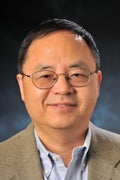
 Yongmin Chen
Brief Professional Information:
Education:
Ph.D. in Economics, Boston University, 1988-1992.
https://www.colorado.edu/economics/people/faculty/yongmin-chen
Academic Positions:
- Professor, Department of Economics, University of Colorado at Boulder, 2005-.
- Provost’s Chair, 2018-.
- Stanford Calderwood Endowed Chair, 2007-2011.
- Associate Chair for Graduate Studies, 2003-2006.
- Associate Professor (Awarded tenure in 2001), Department of Economics, University of Colorado at Boulder, 2001-2005.
- Assistant Professor, Department of Economics, University of Colorado at Boulder, 1996-2001.
- Visiting Assistant Professor of Economics, John M. Olin School of Business, Washington University, 1992-96.
Other Professional Positions/Services:
- Associate Editor, RAND Journal of Economics, 2012-.
- Managing Editor, International Journal of Industrial Organization, 2013-2019.
- Co-Editor, International Journal of Industrial Organization, 2011-2012.
- Associate Editor, European Economic Review, 2002-2012.
- Associate Editor, Journal of Industrial Economics, 2004-2010.
- Associate Editor, Quantitative Marketing and Economics, 2010-2013.
- Editorial Advisor, Canadian Journal of Economics, 2005-2008.
- Visiting Professor of Economics, Hong Kong University of Science and Technology, Fall 2009.
- Short-term/summer visiting professor at several universities and for various times, since 2001.
- Consultant, United States Federal Communications Commission, 2012.
- Member, Vice Chancellor’s Advisory Committee (VCAC), University of Colorado Boulder, 2012-14.
- Member, Provost’s Advisory Committee, University of Colorado Boulder, 2014-15.
- Panel Member of Hong Kong Research Grants Council: Business Studies Panel (2014-19), Collaborative Research Fund Selection Panel (2023-26).
New for Fall 2023:
-
I am on sabbatical during Fall 2023, making short visits to several universities.
-
I am involved with organizing the 2023 Asia-Pacific Industrial Organization Conference (APIOC 2023), Dec. 15-17, Hong Kong.
Research:
-
Fields: industrial organization (IO); microeconomic theory
-
Interests: price theory; consumer search; innovation and intellectual property; law and economics; antitrust; vertical contracting
-
Working papers and publications; Google Scholar; RePec
Recognition for Research Excellence:
- BFA Excellence Award for Research, Scholarly, and Creative Work, University of Colorado at Boulder, 2014-2015.
This award recognizes my work in the field of industrial organization that “has advanced understanding of several crucial issues, including how firms make dynamic price decisions, how they structure vertical relations, and what determine incentives for innovation.”
Recognition for Teaching Excellence:
- Stanford Calderwood Teaching Excellence Award, Economics Department, CU-Boulder, 1999.
Recognition for Service Contributions:
- BFA Faculty Recognition Award, University of Colorado at Boulder, October 2013.
Awards for Research/Scholarship:
- BFA Excellence Award for Research, Scholarly, and Creative Work, University of Colorado at Boulder, 2014-2015.
- John Weatherall Distinguished Fellow, Queen’s University, February 29 - March 4. 2016
- Summer Research Grant, the NET Institute, 2012.
- Research Grants Council (RGC), Hong Kong, Grant # 642211, Co-Investigator, 2011-2012.
- Chang-Jiang Scholar, Ministry of Education of China, 2009.
- Stanford Calderwood Endowed Chair, the University of Colorado at Boulder, 2007-2011.
- Summer Research Grant, the NET Institute, 2007.
- Summer Research Grant, the NET Institute, 2006.
- Best Published Faculty Paper in Public Policy, Department of Economics, CU-Boulder, 2005.
- Faculty Fellowship, Council on Research and Creative Work, University of Colorado at Boulder, 2002-03.
- National Science Foundation, grant #SES 9911229, "Competition and the Vertical Organization of Industries", Principal investigator, 2000-02.
- Stanford Calderwood Teaching Excellence Award, Department of Economics, CU-Boulder, 1999.
- Council on Research and Creative Work, University of Colorado at Boulder, Small Grant, 1999.
- National Science Foundation, grant #SES 9222903, "Dynamic Duopoly and Bounded Rationality", Co-Principal investigator, 1993-94.
- World Bank Graduate Scholarship, The World Bank, 89-91.
- Presidential University Graduate Fellowship, Boston University, 88-89.