|
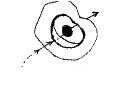
"(v) in all languages means the turning of one point around another, either in a full circle or only a part of one, along an arc, up or down. |
|
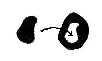
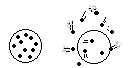
(kh) means a closed curve that shields the location of one poing from the movement toward it of another poing (a protective line). |
|
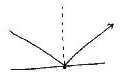
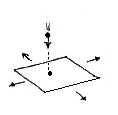
(z) means the reflection of a moving point from the surface of a mirror at an angle equal to the angle of incidence. The impact of a ray upon a solid surface. |
|
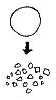
(m) means the disintegration of a certain quantity into infinitely small parts (within certain limits) equal as a whole to the original quantity. |
|
(sh) means the merging of several surfaces into a single surface and the merging of the boundaries between them. The striving of the one-dimensional world of any given dimension to describe a larger area of a two-dimensional world. |
|
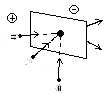
(p) means the increase along a straight line of the empty space between the two points. The movement along a straight line of one point away from another and, as in the sum of a point set, the rapid growth in the volume occupied by a certain number of points. |
|
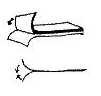
(ch) means the empty space of one body containing the volume of another body, in such a way that the negative volume of the first body is exactly equal to the positive volume of the second. This is a hollow two-dimensional world that serves as a envelope for a three-dimensional body-- within certain limits. |
|
(l) means the diffusion of the smallest possible waves on the widest possible surface perpendicular to a moving point, the height vanishing with the increase in width, for a given volume the height becomes infinitely small as the other two axes become infinitely large. The formation of a two-dimensional body out of a three-dimensional one. |
|
(k) means the absence of motion, a set of n points at the rest, the preservation of their relative positions; the termination of movement. |
|
(s) means a fixed point that serves as a point of departure for the motion of many other points which begin their trajectory there. |
|
(t) means a direction, wherin a fixed point creates an absence of motion among a set of motions in the same direction, a negative trajectory and its direction beyond a fixed point. |
|
(d) means the transposition of a point from one system of points to another system, which is then transformed by the additionof that point. |
|
(g) means the largest possible oscillations, whose height is perpendicular to the motion and which are extended along the axis of motion. Movements of maximum height. |
|
(n) means the absence of points, an empty field. |
|
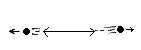
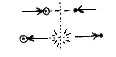
(b) means the meeting of two points moving along a straight line from opposite directions. Their clash, the reversal of one point by the impact of the other. |
|
(ts) means the passage of one body through an empty space in another. |
|
(shch) means the laying out of a whole surface into separate sections, the volume remaining fixed. |
|
(r) means the division of a smooth hollow body as a trace of the movement of another body through it. |
|
(zh) means motion out of a closed volume, the separation of free point systems." |