Paul Beale
Professor of Physics and Chair
Department of Physics
University of Colorado at Boulder
R. K. Pathria and Paul D. Beale, Statistical Mechanics
Third Edition (Academic, Boston, 2011)
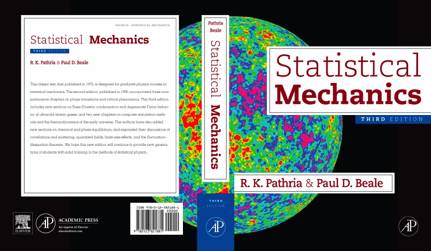
This new edition of Raj
Pathria's classic graduate statistical mechanics textbook includes new sections
on Bose-Einstein condensation and degenerate Fermi behavior of ultracold atomic
gases, and two new chapters on computer simulations and thermodynamics of the
early universe. The authors have also added new sections on chemical and phase
equilibrium and expanded their discussions of correlations and scattering, quantized
fields, finite-size effects, and the fluctuation-dissipation theorem. We hope
this new edition will continue to provide new generations of students with
solid training in the methods of statistical physics. The web page for the book
can be found at http://elsevierdirect.com
Associated Mathematica
files for solving the two-dimensional Ising model on a finite square lattice can
be found here.
Monte Carlo simulation of a fluid
Same page but with a Molecular Dynamics Simulation
Paul D. Beale
Professor of Physics and Chair
Department of Physics
E1B32 Duane Physics, 390 UCB
University of Colorado at Boulder
Boulder, CO 80309-0390
(303) 492-0297 (Chair's Office)
(303) 492-1685 (Faculty Office)
(303) 492-2998 (FAX)
Paul.Beale@Colorado.edu
Home Page:
http://spot.colorado.edu/~beale
Try the States
of Matter Java Applet on the Physics Education Technology Web site:
Explore the solid, liquid and vapor phases of neon, argon, oxygen and water.
The PhET simulation was based on my molecular dynamics code used in the applet
above.
The following link is Java applet that simulates the two-dimensional Potts
model.
Potts Model Java Applet
visitors since August 12, 2004
B.S. Physics,
University of North Carolina, Chapel Hill (1977)
Ph.D. Physics Cornell University, 1982.
Professor of Physics, University of Colorado at Boulder (1997-)
Associate Professor of Physics, University of Colorado at Boulder (1991-1997)
Assistant Professor of Physics, University of Colorado at Boulder (1984-1991)
Postdoctoral Research Associate, Department of Theoretical Physics, Oxford
University (1982-1984).
My general field of research is the thermodynamics and statistical mechanics of
condensed matter systems. This includes theoretical studies related to critical
phenomena and phase transitions, ferroelectrics, Landau theories, hysteresis in
spin models, magnetic materials, failure modes in random materials, theories of
melting, effects of noise on nonlinear dynamical systems, phenomenological
finite-size scaling, Monte Carlo methods, commensurate-incommensurate
transitions, renormalization-group methods, and structural phase transitions.
My recent work includes a calculation of the exact distribution of energies in
the two-dimensional Ising model. By using Kauffman's generalization of
Onsager's solution of the two-dimensional Ising model, one can calculate the
exact form of the partition function in the form of a low-temperature series
expansion. Since the coefficients of the low-temperature series give the number
of different states with a given energy, one can use the coefficients to
calculate the exact distribution of energies at any specified temperature. This
solution provides an exact distribution that can be used to verify the accuracy
and convergence of Monte Carlo simulations.
Selected Publications:
"Grain Boundary Free Energy in an Assembly of Elastic Disks", Mark T.
Lusk and Paul D. Beale, Physical Review E, 69, 026117 (2004).
"Three-Dimensional Hard Dumbbell Solid Free Energy Calculation Via the
Fluctuating Cell Model", Steven A. Kadlec, Paul D. Beale and James
Rainwater, Proceedings of the Fifteenth Symposium on Thermophysical Properties,
published in the International Journal of Thermophysics, 25 1415 (2004).
"Acoustic Crystal Thermodynamic Integration Method", Paul D Beale,
Physical Review E 66, 036132-036139 (2002).
"Two Dimensional Hard Dumbbells,: I. Flucutating Cell Model", S. C.
Gay, J. C. Rainwater, P.D. Beale, Journal of Chemical Physics, 112,
9841-9848 (2000).
"Thermodynamic perturbation theory applied to the dipolar heteronuclear
dumbell fluid", S.C. Gay, P.D. Beale and J.C. Rainwater, Mol. Phys., 96,
301 (1999).
"Solid-liquid equilibrium of dipolar heteronuclear dumbells in a
generalized van der Walls theory: Application to methyl chloride", S.C.
Gay, P.D. Beale and J.C. Rainwater, J. Chem. Phys., 109, 6820 (1998).
"Exact Distribution of Energies in the Two-Dimensional Ising Model",
Paul D. Beale, Physical Review Letters 76, 78-81 (1996). You can
download a Mathematica routine that will calculate the exact partition function
for the two dimensional Ising model on an nxm lattice. The program determines
the coefficients of the low temperature power series expansion. IsingExactMathematica.html
"Breakdown of Two-Phase Random Resistor Networks," P.M. Duxbury, P.D.
Beale, Phys. Rev. B 51, 476 (1995).
"Comparison of Classical Nucleation Theories with Monte Carlo Simulations
of Ising Models," Paul D. Beale, Integrated Ferroelectrics 4,
107-111 (1994).
"Dielectric Breakdown in Continuous Models of Metal-Loaded
Dielectrics," Mark F. Gyure, Paul D. Beale, Phys. Rev. B 46,
3736-3746 (1992).
"Grain-size effects in ferroelectric switching," H.M. Duiker, P.D.
Beale, Phys. Rev. B 41, 490-495 (1990).
"Noise-induced escape from attractors in one-dimensional maps," P.D.
Beale, Phys. Rev. A 40, 3998-4003 (1989).
"Elastic fracture in random materials," P.D. Beale and D.J.
Srolovitz, Physical Review B. 37, 5500-5507 (1988).
"Dielectric breakdown in metal-loaded dielectrics," P.D. Beale and
P.M. Duxbury, Physical Review B. 37, 2785-2791 (1988).
"The breakdown properties of quenched random systems - the random fuse
network," P.M. Duxbury, P.L. Leath and P.D. Beale, Physical Review B 36,
367-380 (1987).
"Size effects of breakdown in quenched random media," P.M. Duxbury,
P.D. Beale and P.L. Leath, Physical Review Letters 57, 1052 (1986).
"Finite-size scaling of the two-dimensional axial next-nearest neighbor
Ising model," P.D. Beale, P.M. Duxbury and J.M. Yeomans, Physical Review B
31, 7166 (1985).
"Finite-size scaling at an Ising tricritical point," P.D. Beale, Journal
of Physics A 17, L335 (1984).
"Wavevector scaling and the phase diagram of the chiral clock model,"
P.M. Duxbury, J. Yeomans and P.D. Beale, Journal of Physics A 17, L179 (1984).
"Renormalization-group study of crossover in structural phase transitions,"
P.D. Beale, S. Sarker and J.A. Krumhansl,Physical Review B 24 , 266 (1981).
Interested in flying? Have a look at my
Beechcraft Bonanza.
Return to the Department of Physics
Home Page