CHIN 1051 Masterpieces of Chinese Literature in Translation 
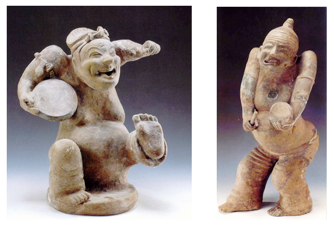 |
This course introduces literary traditions of China from the very beginnings in the second millennium CE to the 19th century, all presented in English translations. Reading and discussing Chinese literature, we discover a broad range of subject matters, styles, and genres: from seemingly non-literary texts (such as oracle bone inscriptions, philosophical writings, chronicles, and biographies) to fictional genres of prose, poetry, and drama. The format of this class includes short lectures to provide historical, cultural, and literary background information as well as discussions about the reading assignments and related issues. |
CHIN 3351 Reality & Dream in Chinese Literature
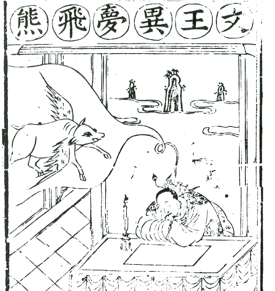 |
The course aims at an understanding of dreams and dreaming as a significant literary topic in China. This focus provides a perspective on Chinese literature that is not as limited as one might expect, because dreams and dreaming are surprisingly widespread in major Chinese texts. We critically read, interpret, discuss, and write about the dreamscapes in philosophical, religious, medical, and historical writings as well as in poetry, fictional prose, and drama, all presented in English translations. Since dreams are such a universal literary topic worldwide and through the ages, we also connect our findings to selected non-Chinese perceptions of dreams in literature, religion, and psychology. The questions we are discussing will be of a similarly broad range as the texts they are derived from: What did dreams mean to the Chinese? What was assumed to cause dreams? Were they regarded as part of or rather as a counterpart to reality? Did the Chinese in antiquity dream different dreams than we do today? To what degree are dreams shaped by culture? This class largely consists of discussions, but also includes short lectures as well as presentations by students. |
CHIN 3361 Women & the Supernatural in Chinese Literature
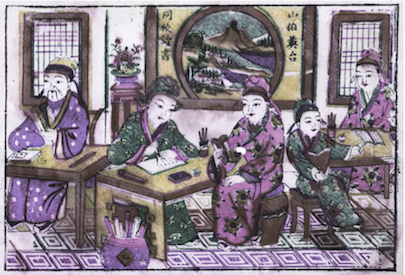 |
In this course, we explore the relationship between the worlds of women and the supernatural in pre-modern Chinese literature and thought. After a short theoretical introduction of the two main topics—the idea of the supernatural and the position of women in China—we critically read, discuss, and write about selected works from imperial China (mostly 3rd to 18th century), all provided in English translations. The readings come from various genres (ballads, stories, and drama) and are diverse in subject matter. We are meeting ghost lovers, animal spirits, celestial wives, filial daughters, fox fairies, superwomen, and cross-dressers; we will follow their feats and fates, observing how they are treated by their almost exclusively male authors. This class will largely consist of discussions about our readings, but will also include lectures providing historical and literary background as well as presentations by students. |
CHIN 3381 Chinese Travel Literature: Journeys Within & Without, Real & Imaginary
| This course explores the world of travel writing in China. Widely different forms of travel, whether real or imaginary, have inspired a broad spectrum of travel literature in China: from landscape poetry describing a hike through ragged mountains to travelogues about an official moving across the country, from factual geographical and environmental reports to fantastical novels about intercultural and interspecies encounters of the strangest kind. Often, these narratives not only delineate the paths of travelers in the outside world, but also how they experienced their journeys, combining rich geographical and cultural descriptions with autobiographical, philosophical, or religious reflections. We are going to read and analyze examples of this tradition in English translations and discuss their implications against the background of Chinese literary history and in the context of our own travel experiences, whether literary or in real life. Our interpretations will be supported by modern critical approaches to travel literature. This class will consist of discussions about our readings, lectures providing historical, cultural, and literary background, as well as students’ presentations. |
CHIN 4042 Readings in Classical Chinese
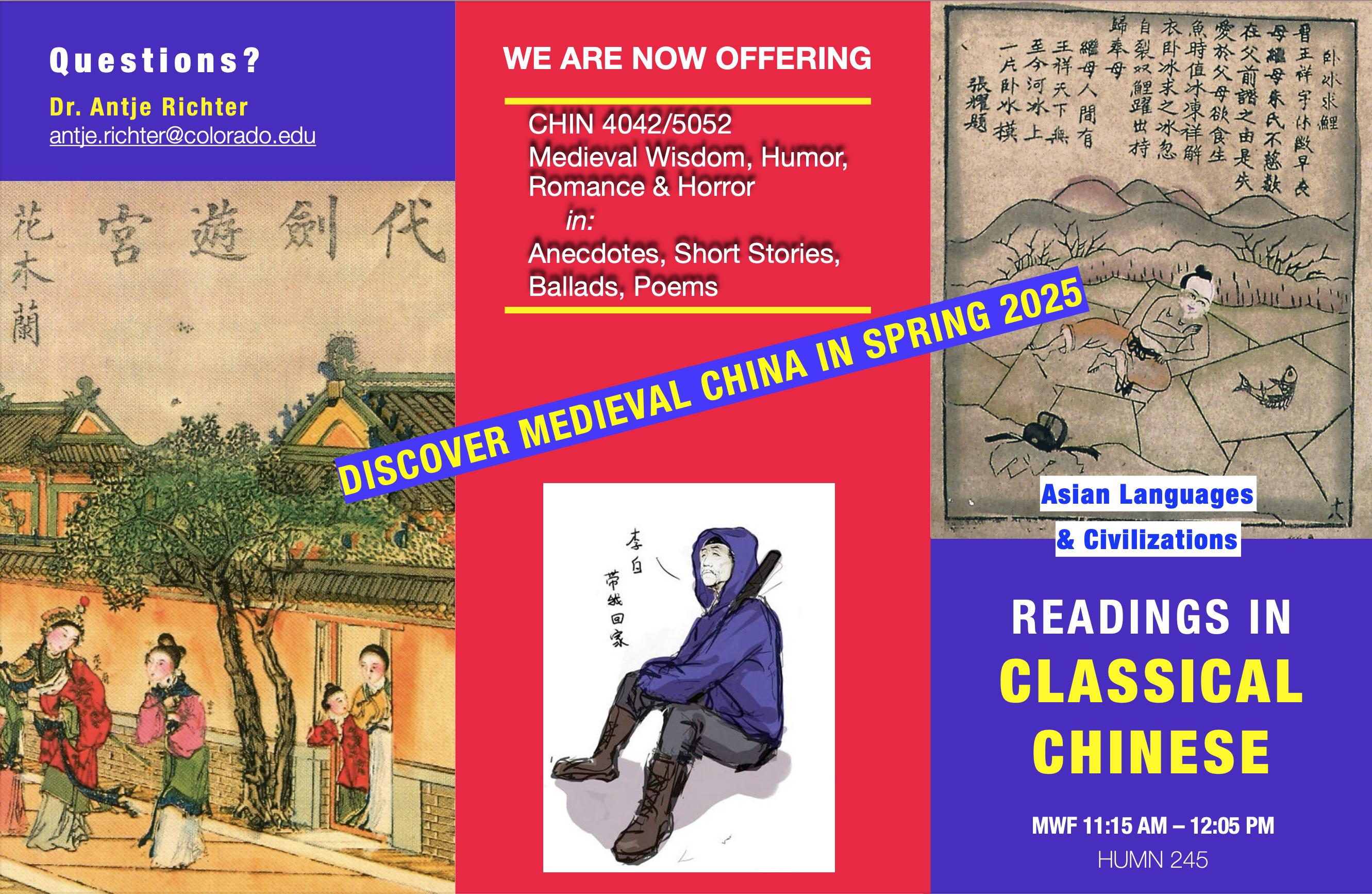 |
This course introduces a wide spectrum of texts from medieval China written in classical and literary Chinese: philosophical, historical, ghost stories, and poems (including the Ballad of Mulan). We will read these texts closely, focusing on their linguistic and literary features and on their cultural background. Requirements: CHIN 4041, or instructor consent. WHY LEARN CLASSICAL CHINESE ? |
CHIN 5010 Sinological Methods
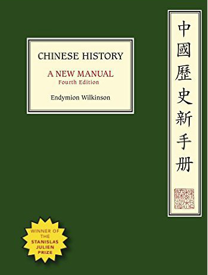 |
What is “Sinology” and how to become a successful member of this scholarly community? These are the two main questions that drive this graduate seminar. It will help you identify, locate, evalu-ate, and use reference works, source materials, books, and articles (in print & online) in a range of fields from literature to history, art, religion, and the sciences. It will also help you to identify pro-ductive areas of research in your main fields of interest and to develop skills in scholarly presenta-tion and writing. All this will be embedded in reflections on Chinese Studies—both as a historically grown intellectual discipline and as our own individual pursuit. The seminar will consist of lectures, exercises, discussions, and students' presentations. |
CHIN 5330 Chinese Literary Thought
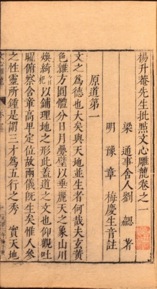 |
Knowledge of indigenous critical approaches to literature is necessary to gain a deeper understanding of Chinese literary history. In this seminar, we are studying major developments in the history of pre-modern Chinese literary thought and their relevance in Chinese intellectual history, aiming at both an overview of the field and the in-depth study and close reading of early medieval core texts. These are quite diverse in character and form, as Chinese literary and critical thought found expression in a broad spectrum of genres from rhapsody to poem, letter, or essay. Our readings will come from Wen xuan (by authors such as Cao Pi, Cao Zhi, Lu Ji, and Xiao Tong), Wenxin diaolong (in particular the chapters "Shen si," "Yang qi," "Li ci," "Xu zhi"), and a variety of other texts. Exploring these texts, many of of which have become influential parts of the literary canon, we will reflect on key issues in literary thought, Chinese as well as Western, such as imagination and literary creativity, canon formation, genre, imagery, reader response, translation, etc. This part of our inquiry will also take important Western approaches to literary thought into account. |
CHIN 5480 Topics in Medieval Literature: Accounts of the Strange
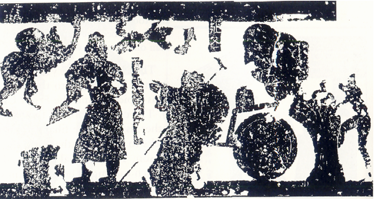 |
This graduate seminar is an introduction to a literary genre that emerged and flourished in Early Medieval China, and proved to be of lasting importance and influence for the rest of Chinese literary history as well. Plots, literary figures, and motifs of traditional zhiguai and chuanqi narratives have remained popular in China up to the present day and keep on inspiring modern literature, film, and new media. We will read, translate, and discuss selected pieces of the genre, starting from the first large collection, Gan Bao's (fl. 317–322) Soushen ji and going on to Tang dynasty tales collected in the Taiping guangji (978) and elsewhere, supported by readings in Western and Chinese scholarship. |
While the exploration of "Accounts of the Strange" touches upon a broad range of questions—historical, anthropological, religious, gender, etc.—our main approach will be literary and, to a certain degree, comparative. Reading these texts with a focus on their narrative features will help us delineate this heterogeneous genre, a fascinating hybrid between history and fiction.
CHIN 5480 Topics in Medieval Literature: Wang Xizhi – Calligraphy and Beyond
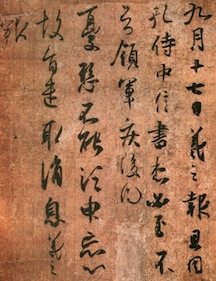 |
In this seminar, we explore the oeuvre and legacy of Wang Xizhi (ca. 303–361). We will read texts ascribed to Wang (the famous "Lanting ji xu" as well as personal letters) along with historical records and anecdotes about him, and members of his family, in texts such as Shishuo xinyu, "Lunshu biao," Jin shu, etc. Reading and analysing these texts will not only help us to situate Wang Xizhi—and Wang Xizhi lore—in the context of fourth-century Southern China, it will also lead us to ponder and discuss issues that are of relevance throughout Chinese literary and intellectual history: from genre questions to the nature of anecdotes, the role of calligraphy, the problem of copying, notions of friendship, the relationship between political engagement and reclusion, and the communication of illness. This seminar does not require previous experience with Chinese calligraphy. |
CHIN 5410 Medieval Prose: Early Buddhist Literature in China
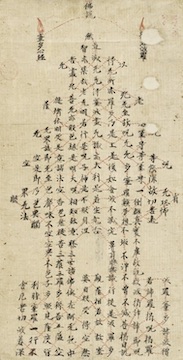 |
This seminar is designed as an introduction to Buddhist literature in medieval China. We will focus on two seminal texts and their reverberations in Chinese literature and culture: the Vimalakīrti sūtra and the Lotus sūtra, chosen for their prominent status among East Asian Buddhist scriptures and for their narrative finesse. We will read these key scriptures (partly in different Chinese translations) as well as excerpts of other Buddhist texts in a spectrum of genres, among them treatises, hagiographies, miracle tales, and travelogues. We will discuss a variety of issues: basic doctrines of Mahāyāna Buddhism and their reception in medieval Chinese poetry and prose, features of early Chinese vernacular as apparent in early Buddhist scriptures, and translation practices in medieval China. Our main focus will be on the literary qualities of these religious texts and on the question of how we are supposed to interpret their narratives of sex change, interplanetary travel, time lords, and other wonders. Based on readings of an inspiring and varied body of scholarship, our discussions will touch upon matters of philosophy, ethics, aesthetics, transculturality, gender, art history, and material culture. |